Inference — /ops/inference
Load a trained model onto the cluster and chat with it, or drive it over an OpenAI‑compatible API. Scoped to the pool selected in the sidebar.
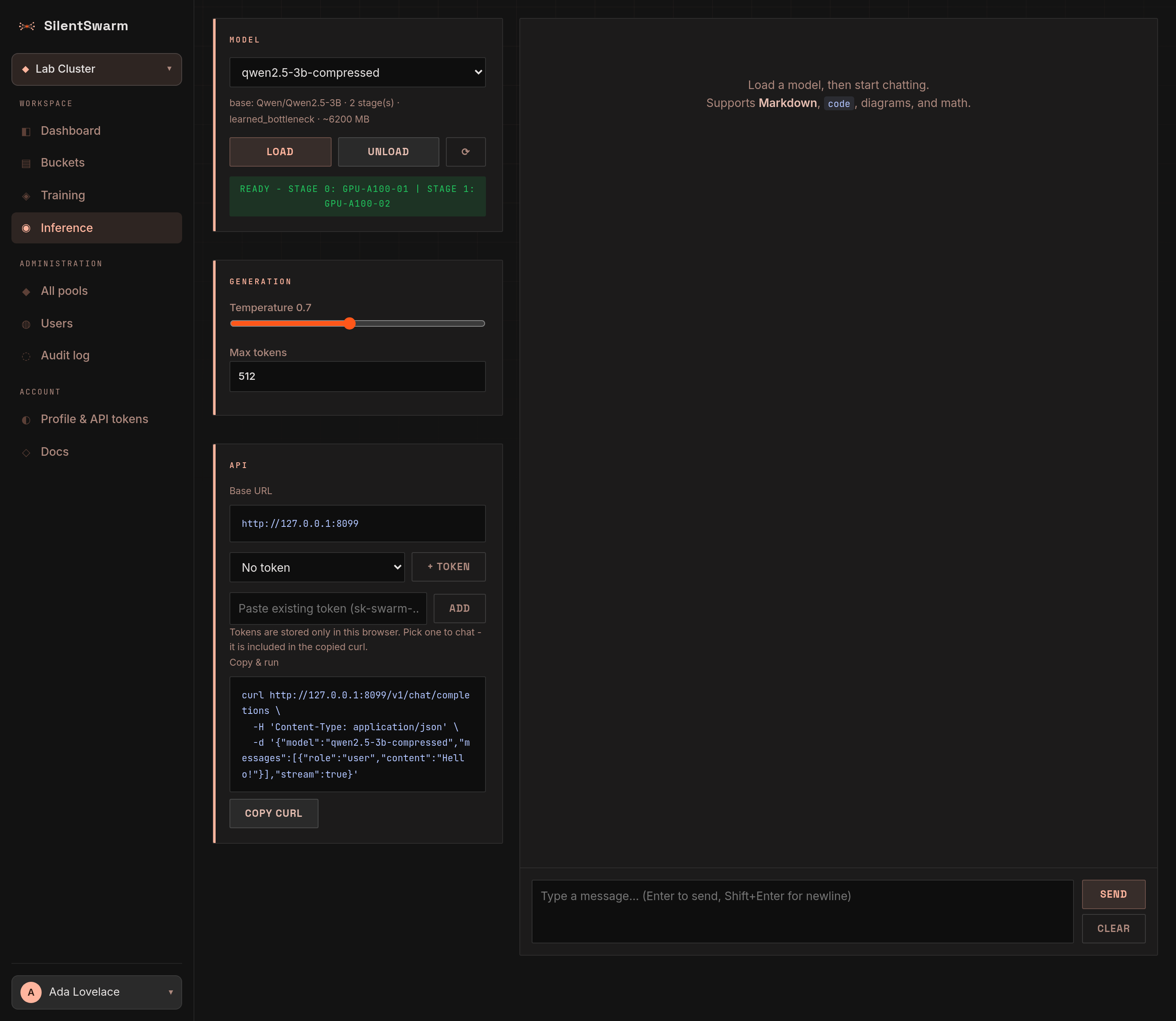
Model (left panel)
- Model dropdown — every model trained and exported in this pool. Each shows its base architecture, compression method, and training loss. Incomplete models (missing a shard from one node) are greyed out.
- Load / Unload — pick a model (and the node to serve it on) and Load; a progress bar tracks download → extract → load‑into‑VRAM. Unload frees the VRAM. The ↻ button refreshes the list.
- Status line — under the buttons, once a load is under way or done: the
overall state plus one entry per pipeline stage (
Stage 0: gpu-a100-01 ·
  L0-18 · 3100 MB
), so you can see which machine holds which layers.
A load can be refused before it starts, with a message like stage 0 on
gpu-1 needs 15.2 GB (9.0 GB weights + 4.8 GB KV cache at 8192 tokens), has 12.0
GB free. That is the leader budgeting the KV cache the stage will allocate on
top of its weights - see Serving VRAM. Serving on a
node with more free VRAM, or lowering SWARM_SERVE_CONTEXT_TOKENS, makes it
fit.
Generation
- Temperature — sampling randomness (0 = deterministic).
- Max tokens — response length cap.
API
Everything you need to call the model programmatically:
- Base URL — the OpenAI‑compatible endpoint.
- Token picker / + Token — create or paste an API token. Tokens are stored
only in your browser and included in the copyable
curl. - Copy & run — a ready‑made
curlagainst/v1/chat/completions.
Chat
The main panel is a chat transcript. Type a prompt and Send (Enter to send, Shift+Enter for a newline); the model streams tokens back. Responses render Markdown, code, diagrams, and math. Clear resets the conversation. Each reply notes which model answered.